
Three Types of Utilities
In Alabama, there are three types of utilities: investor-owned, municipal/public power, and cooperative.
| Utility Type | Example Companies | PSC Regulation? |
| Investor‑Owned Utility | Alabama Power Company | ✅ Regulated by PSC |
| Municipal/Public Power Utilities | Athens Utilities, Huntsville Utilities, etc. | ❌ Not PSC‑regulated |
| Rural Electric Cooperatives | Wiregrass EC, Cullman EC, Arab EC, etc. | ❌ Not PSC‑regulated |
Investor‑Owned Utility Regulated by the PSC
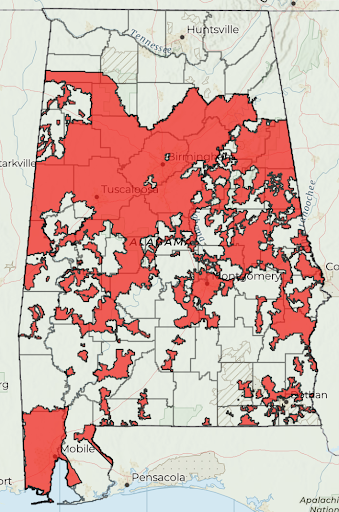
Alabama Power Company is the only investor‑owned electric utility under the jurisdiction and regulation of the Alabama Public Service Commission (PSC).
The utility generated 139.4 terawatt-hours of electricity in 2023 from its 15,800 megawatt capacity portfolio, with a generation mix of 45.1% natural gas, 31.1% nuclear, 14.6% coal, and smaller portions of hydroelectric and renewables.
More than 1.5 million Alabamians are Alabama Power customers. Despite residential rates near the national average at 11.4 cents per kilowatt-hour, Alabama customers pay the highest monthly electric bills in the nation at $179-182. The utility charges residential customers an average of 15.03 cents per kilowatt-hour as of 2024, with recent rate adjustments including a 4.87% increase approved for 2025.
Alabama’s electricity market operates as a fully regulated monopoly system. It is dominated by Alabama Power Company which has territory across the southern two-thirds of the state, meaning 100% of its customers have no alternative electricity provider options.
Alabama Power Dominates with Guaranteed Profits
Alabama Power operates under a unique Rate Stabilization and Equalization system that guarantees the company a 13-14.5% return on equity, significantly higher than the 9.51% industry average. This regulatory structure generated over $2 billion in excess profits between 2014-2022 compared to typical utility returns.
Municipal Utilities Offer Lower Rates Through TVA Partnership

Six major municipal electric utilities operate in northern Alabama, collectively serving over 300,000 customers with rates 25-27% lower than Alabama Power. These community-owned, non-profit utilities purchase 100% of their power wholesale from the Tennessee Valley Authority at approximately 7 cents per kilowatt-hour, then add local distribution costs. They are regulated by local governing bodies – like a city council or dedicated utility commission – and not regulated by the Public Service Commission.
Alabama’s Largest Municipal Utilities
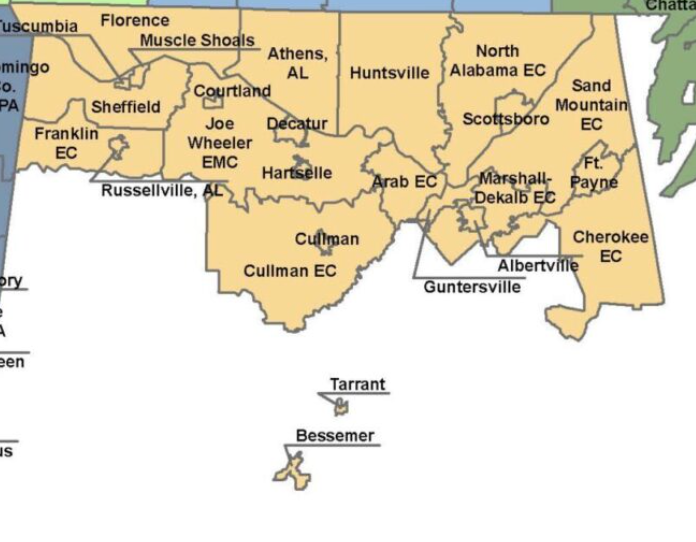
Huntsville Utilities leads the municipal sector with 218,267 customers across 800 square miles of Madison County and portions of Marshall and Jackson counties. The utility maintains residential rates at approximately 11.60 cents per kilowatt-hour with average monthly bills of $146.61. Athens Utilities serves 40,000 customers throughout Limestone County with rates of 11.15-11.25 cents per kilowatt-hour, while Decatur Utilities provides service to 30,000 customers in Morgan County. Smaller municipal systems include Florence Utilities in Lauderdale County, Guntersville Electric Board, and Scottsboro Electric Power Board serving 8,500 customers while uniquely offering telecommunications services alongside electricity.
All municipal utilities in North Alabama face pressure from TVA’s 5.25% wholesale rate increase in 2024, the largest in 16 years, forcing local rate adjustments despite their non-profit structure. However, local control and community ownership enable these utilities to maintain significantly lower rates than Alabama Power.
Rural Cooperatives Serve Alabama’s Most Challenging Territories
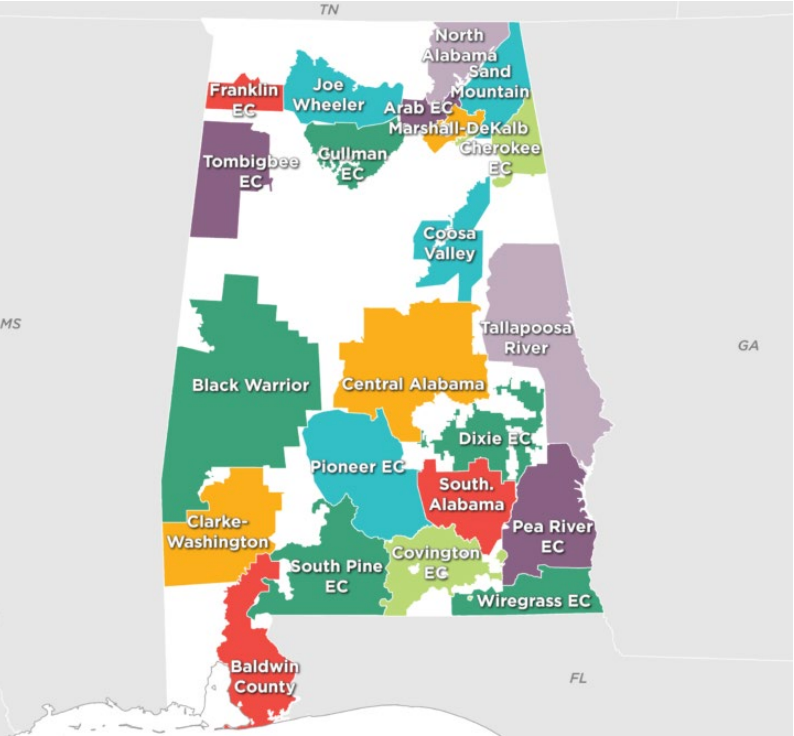
Alabama’s 23 electric cooperatives. PowerSouth is the only generating cooperative, and 22 others distribute power to homes and businesses. Together, they serve over 1 million people across 70% of the state’s land mass, maintaining 71,000 miles of power lines with an average of only 7 customers per mile compared to Alabama Power’s 18 customers per mile. Despite this infrastructure challenge, most cooperatives maintain competitive rates through their member-owned, non-profit structure.
Key Characteristics of an Electric Cooperative:
- Member-Owned:
The customers (called “members”) are also the owners. Each member typically has one vote in co-op decisions, such as electing the board of directors. - Nonprofit:
Electric co-ops operate on a cost-of-service basis. Any profits (called margins) are either reinvested in the co-op or returned to members as capital credits. - Local Governance:
A board of directors, elected by the members, sets policies and oversees the co-op’s operations. They are independent of PSC oversight. - Community Focused:
Because they serve specific local areas, electric co-ops often focus on reliability, affordability, and community development rather than maximizing profits. - Rural Origins:
Electric co-ops were largely created in the U.S. after the Rural Electrification Act of 1936 to bring power to rural regions where for-profit utilities wouldn’t invest. - Power Distributors:
Co-ops generally do not generate their own electricity. PowerSouth is the only co-op in Alabama that generates power. Instead, most purchase power from other generators, such as PowerSouth and TVA to distribute to their customers.
PowerSouth Energy Cooperative operates as the generation and transmission provider for 16 distribution cooperatives and 4 municipal systems, serving nearly 800,000 consumers across 39 Alabama counties. PowerSouth owns over 2,000 megawatts of generating capacity from natural gas, coal, hydroelectric, and nuclear sources, plus 2,200 miles of transmission lines. Individual distribution cooperatives range from Joe Wheeler EMC with 43,000 members across Morgan and Lawrence counties to smaller systems like Franklin Electric Cooperative serving 8,127 customers with exceptional 2.85% energy loss rates.
Cooperative rates vary significantly based on location and power supply source. Sand Mountain Electric Cooperative offers the lowest rates at 12.63 cents per kilowatt-hour, 21% below the state average, while serving 33,904 customers and generating $73.77 million in annual revenue.
Arab Electric charges 12.14 cents serving 15,591 accounts, while Cherokee Electric’s 26,691 customers pay 14.84 cents. Tombigbee Electric Cooperative has the highest cooperative rates at 16.91 cents per kilowatt-hour, 7% above the state average, while serving 10,000 members in northwest Alabama. Northern Alabama cooperatives purchasing from TVA generally achieve lower rates than those supplied by PowerSouth in central and southern regions.